Geopolitical Lessons from 250 Years of US History
Overview
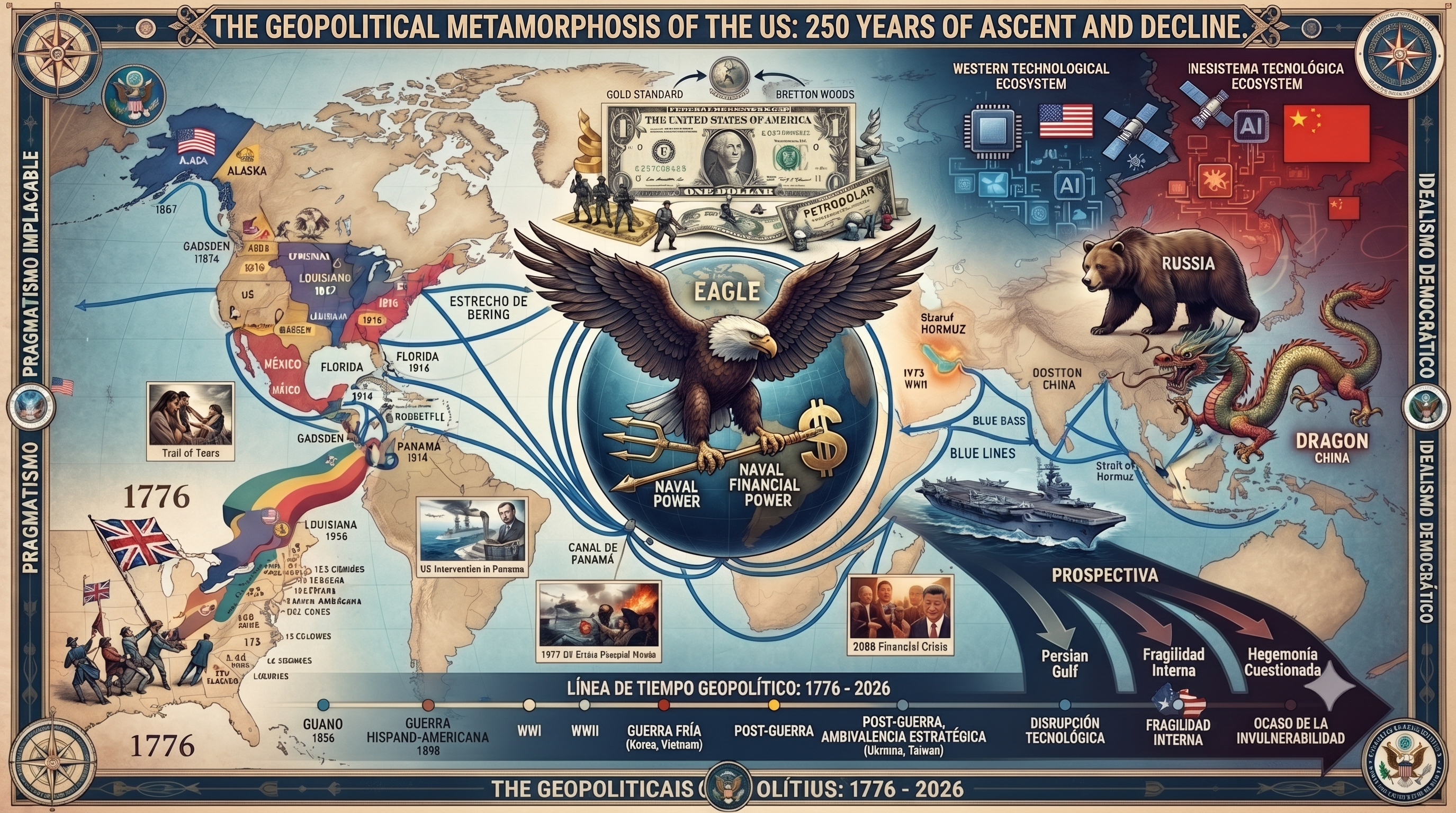
The history of the United States is not merely the chronicle of an expanding nation, but the most thoroughly studied laboratory of modern geopolitics. From its birth as a republic founded upon a set of thirteen peripheral colonies to its consolidation as a global hegemonic power, the American trajectory has been guided by a relentless pragmatism, often disguised as democratic idealism.
This paper examines Washington’s trajectory through the prism of geopolitical transcendence, relating to the constant pursuit of security, the control of maritime lines of communication, the projection of soft and hard power, and the management of financial complexity that has sustained its dominance.
In that vein, we will explore how the metamorphosis of American power—besieged by China, Russian voracity, Europe's reactive position, Islamic terrorism, drug trafficking, illegal migration, and Trump's volatility of character—reveals both the constants and the contradictions of a power that, today, faces the challenge of maintaining its invulnerability in a scenario different from that of the Cold War with the Soviet Union and the military, technological, and commercial luster of the post-1945 era.
Territorial Imperative Marked from Birth to Consolidation Birth as a nation-state governed republicanly, upon the foundations of thirteen British colonies that rebelled against the Crown, was not solely the publicized act of Manifest Destiny, but an exercise in geopolitical realism.
In reality, the alliance with France, Spain, and the Netherlands caused a geopolitical and geostrategic fracture for the empire of King George III. The independence of the 13 colonies was not the end, but rather the freeing of its own hands for the expansion of a new vision of planetary geopolitical presence.
The War of 1812 against the British Crown demonstrated that the national security of the American Union required control of continental borders, while the Monroe Doctrine, published in 1823, indicated the unilateral selection of the American hemisphere as an exclusion zone for powers from the Old Continent, in a scenario dubbed a "backyard" under Washington's tutelage.
The 19th century was a vortex of territorial purchases, such as Florida, Louisiana, and Alaska, and the forced annexation of part of Mexico's territory. The Guano Islands Act of 1856 is an early example of how the United States understood that strategic resources were vital for its security and the projection of its power.
At the same time, the obsession with the physical presence and control of the sea found its mentor in Admiral Alfred Thayer Mahan, whose thesis on sea power convinced Washington that national greatness depended on the dominion of oceanic routes, a powerful navy, commercial preeminence, and financial investment in the world's main ports and markets. This vision propelled the construction of the Panama Canal, thanks to Theodore Roosevelt's Corollary, which instrumentalized "international law" by despoiling the Isthmus of Panama, separating it from Colombia to secure the interoceanic passage.
Era of the Two World Wars and the Post-War Syndrome The United States entered World War I to prevent a German continental hegemony that would threaten the balance of the Atlantic. However, its subsequent withdrawal from the Treaty of Versailles was a geopolitical miscalculation. It is simple: a global power cannot retreat from the institutions that it helped to mold.
World War II consolidated the "American Century." Upon its conclusion, with Europe in ruins, the United States emerged as the only nation capable of sustaining the capitalist system. Following the geoeconomic design of Bretton Woods, the US dollar became the global reserve currency, mutating toward the petrodollar scheme in the 1970s.
That is to say, the White House financed its military expansion by printing the currency that the rest of the world needed to purchase energy and conduct commercial transactions. However, the luster of American power began to tarnish after World War II. The fiasco in Korea—a stalemate in the geopolitical chessboard—was the starting point for the "Vietnam Syndrome," where it was demonstrated that technology cannot bend cohesive national wills sheltered by guerrilla warfare and prolonged attrition without precisely locating the adversary on the ground.
Strategic Ambivalence: From Taiwan to Ukraine On the global geopolitical chessboard, Washington manages a calculated strategic ambivalence to contain its rivals. The policy regarding Taiwan—a de facto autonomy backed militarily but under deliberate diplomatic ambiguity—seeks to partially curb Chinese expansion without precipitating an open conflict.
This stance finds an echo in the conflict in Ukraine. It is not moral inconsistency, but rather an architecture of containment where fluctuating support for Ukraine against Russia allows for the attrition of the adversary's projective capacity without Washington committing troops to the front, prioritizing the preservation of its own regional strategic advantage.
Technological Struggle and the Persian Gulf, the New Battlefield The Washington-Beijing relationship mutated from classic commercial competition to a zero-sum technological war. The contest for semiconductors, dominance in Artificial Intelligence, and sovereignty over 5G and 6G fiber optic networks are pillars of 21st-century national security.
The United States employs a strategy of "technological asphyxiation," restricting China's access to critical tools and talent, while Beijing responds with an ambitious program of radical self-sufficiency and dominance of the rare minerals industry. This forced decoupling is reconfiguring global supply chains, forcing third countries to choose blocs, which tends to fracture the world economy into incompatible ecosystems.
In parallel, the Strait of Hormuz remains an epicenter of instability. The outcomes of the crisis in this zone under the current administration point to a high-tension scenario where the US financial "handicap" is pressured by a growing alliance between Iran, Russia, and China. If Washington persists in a policy of maximum sanctions without a diplomatic strategy of containment in the Gulf, it runs the risk that rival powers will end up consolidating an alternative energy route that completely bypasses the control of the dollar and the US Navy.
Prospects: Realistic Scenarios
-
In the Persian Gulf: Instability favors actors seeking to displace Washington, forcing it to maintain a costly military presence that drains its budget while China gains commercial influence.
-
Internal Fragility: The greatest geopolitical risk for the United States remains its inability to combat drug trafficking within its borders, while demanding external controls from its partners. This disconnection erodes its legitimacy as a leader of the global order. And although it does not currently impact internal elections, over time it would compound problems derived from immigration, inflation, and alarming bipartisan polarization.
-
Questioned Hegemony: The future of American geopolitics will depend on whether the current administration can transcend the immediate technological struggle and design a model of competition that does not turn the rest of the world into a chessboard of tactical sacrifices.
Conclusion The geopolitical lesson of 250 years is clear: geopolitics favors the actor that understands that power is not just military force, but the capacity to project a stable vision. For reflection, Washington has transitioned from the architect of the world to a defensive actor, whose greatest threat lies within China, and in its own difficulty to harmonize external actions with internal realities.
About the Author: Lieutenant Colonel Luis Alberto Villamarín Pulido is a veteran officer of the Colombian Army and a renowned international analyst of strategic affairs, geopolitics, and national security. He is the author of more than 40 books on the Colombian conflict and international terrorism. He is also an international speaker and expert consultant on defense and military leadership for the world's most prominent Spanish-language media outlets.
Comentarios
Inicie sesión para participar en la conversación.
Iniciar Sesión